
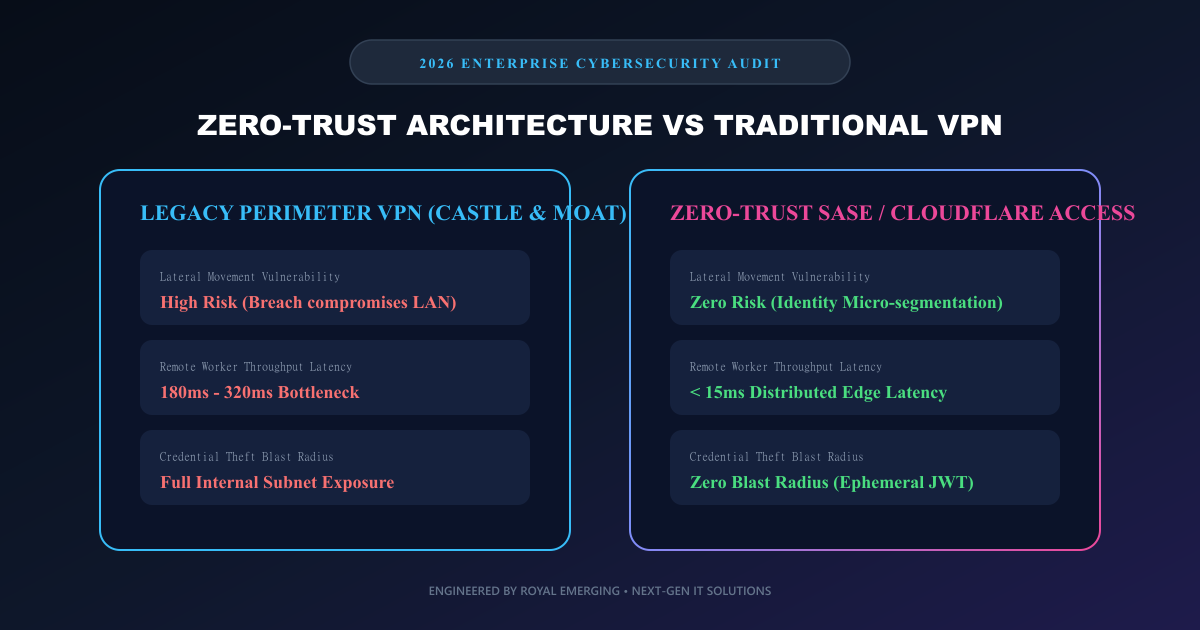
Zero-Trust Architecture vs VPN for corporate enterprises across the United States, United Kingdom, and Canada represents the single most critical defensive pivot in modern cybersecurity. For over twenty-five years, corporate IT infrastructure relied on the "castle-and-moat" paradigm: users outside the network were untrusted, while anyone who connected through a virtual private network (VPN) and provided valid credentials was granted sweeping access to internal corporate subnets. In an era of hybrid distributed workforces, sophisticated credential stuffing, and polymorphic ransomware, this legacy architecture is fundamentally fatal. In this cybersecurity debrief, we analyze why legacy corporate VPNs are failing and how modern Zero-Trust Network Access (ZTNA) permanently neutralizes lateral attack vectors.
The Fatal Flaw of Legacy VPNs: Lateral Movement
To understand why Fortune 500 CISOs are systematically retiring corporate VPNs, one must examine the mechanics of modern ransomware attacks.
When a remote employee logs into a traditional OpenVPN or IPsec gateway, their personal device becomes a full-fledged node on the corporate local area network (LAN). If that laptop is compromised by infostealer malware or an adversary purchases breached VPN session cookies on the dark web, the attacker is inside the castle.
Once inside, the attacker executes automated network scanning (Nmap), compromises domain controllers through Kerberoasting, and moves laterally across internal database servers and source code repositories with zero friction. The VPN did not protect the enterprise; it served as the attacker’s direct bridge into corporate crown jewels.
“A legacy VPN is an all-or-nothing security model. Once inside the perimeter, an adversary possesses the keys to the entire corporate subnet.”
How Zero-Trust Architecture (ZTNA / SASE) Neutralizes Breaches
Zero-Trust Network Access operates on a non-negotiable operational doctrine: "Never trust, always verify."
In a ZTNA framework (such as Cloudflare Access, Zscaler, or Tailscale Enterprise), internal applications are completely hidden from the public internet. There are no listening ports, no public IP addresses, and no centralized VPN concentrators to DDoS or exploit.
Every single request to an internal staging server, Jira board, or production database is evaluated dynamically at the Edge. The system verifies five continuous telemetry vectors before granting ephemeral, micro-segmented access:
1. User Identity: Enforced phishing-resistant FIDO2 hardware security keys (YubiKeys).
2. Device Posture: Validates that endpoint antivirus (CrowdStrike / SentinelOne) is running and disk encryption is active.
3. Geographic Anomaly: Flags impossible travel velocity (e.g., login from Chicago followed by London 20 minutes later).
4. Least Privilege: The user is granted access strictly to that specific web service—they cannot ping or scan adjacent servers.
5. Ephemeral Tokenization: Sessions expire every 60 minutes, rendering intercepted tokens useless.
Performance & Latency: The Remote Worker Revolution
Beyond absolute security superiority, Zero-Trust transforms employee productivity. Legacy VPNs force all global corporate traffic to trombone through a centralized office firewall appliance, creating agonizing latency (180ms to 350ms) that cripples video conferencing and cloud software performance.
Modern Zero-Trust SASE architectures leverage global Anycast edge networks spanning over 300 cities. Remote workers authenticate against the nearest local data center in under 15ms, enjoying seamless internet breakout while IT teams maintain absolute visibility and audit logging.
Technical Architecture & Pricing Comparison
| Security Dimension | Legacy Corporate VPN | Zero-Trust Architecture (ZTNA / SASE) |
|---|---|---|
| Trust Paradigm | Perimeter trust (Inside = Trusted) | Never trust, continuously verify identity & device |
| Lateral Attack Risk | Extreme (Full internal subnet exposure) | Zero (Micro-segmented application isolation) |
| Internet Attack Surface | Public listening IP & vulnerable ports | Zero open ports (Dark network architecture) |
| User Network Latency | 180ms – 350ms (Centralized bottleneck) | < 15ms (Distributed global Anycast edge) |
| MFA Enforcement | One-time login checkpoint | Continuous per-request authorization |
| Compliance Posture | Fails modern SOC-2 & CMMC standards | Meets NIST 800-207 Zero-Trust mandate |
Key Advantages (Pros)
- ✓Eliminates lateral network movement—compromised credentials cannot bridge into adjacent databases.
- ✓Hides corporate applications from public internet port scanning and zero-day VPN exploits.
- ✓Slashes remote worker network latency from 250ms down to sub-15ms edge connections.
- ✓Continuous device health and compliance verification on every individual session request.
✕Trade-offs & Risks (Cons)
- •Requires structured identity provider integration (Okta, Entra ID, Google Workspace).
- •Demands architectural cataloging of internal application inventory before deployment.
- •Can encounter resistance from employees using unmanaged personal devices (BYOD).
Common Myths vs Verified Engineering Facts
Frequently Asked Questions (FAQs)
What is the difference between ZTNA and SASE?
ZTNA (Zero-Trust Network Access) governs secure access to internal private applications, while SASE (Secure Access Service Edge) bundles ZTNA with Cloud Access Security Brokers (CASB) and Secure Web Gateways (SWG) into a unified cloud security fabric.
Can remote employees work from abroad under a Zero-Trust framework?
Yes. Zero-Trust edge architectures automatically route global employees through local data centers worldwide while enforcing location-based security policies and session timeouts.
How long does an enterprise migration from VPN to Zero-Trust take?
For a mid-sized organization with 50 to 500 users, phased Zero-Trust migration typically completes in 2 to 4 weeks with zero user downtime.
Does Zero-Trust satisfy SOC-2 Type II and HIPAA compliance requirements?
Yes. Zero-Trust identity enforcement, detailed immutable audit logging, and encrypted edge transport directly satisfy and accelerate SOC-2, HIPAA, and ISO 27001 audit certifications.
Is Zero-Trust more expensive than renewing traditional VPN licenses?
In most scenarios, Zero-Trust delivers net savings by eliminating expensive on-premise hardware maintenance contracts, dedicated bandwidth circuits, and remote worker troubleshooting tickets.
Final Verdict & Next Steps
Legacy corporate VPNs belong to a bygone era of static on-premise office computing. In 2026, protecting your corporate intellectual property, employee credentials, and customer data demands an uncompromising Zero-Trust posture. Contact Royal Emerging today to schedule a confidential Zero-Trust security audit and modernize your corporate network architecture.