In 2026, the retail checkout line is the frontline of customer retention and profitability. Yet over 60% of brick-and-mortar retail stores and wholesale distributors still rely on monolithic, Windows-only desktop billing software built in the early 2000s. These antiquated installations suffer from frequent database corruptions, painfully slow checkout speeds, and zero real-time visibility across multiple store branches. This engineering guide evaluates why leading retailers are migrating to edge-deployed cloud ERP solutions like RE Management (https://is.royalemerging.com) to automate barcode invoicing and protect gross margins.
The Hidden Cost of Legacy POS Latency
During peak shopping hours, every second of checkout latency compounds into lost revenue and cashier fatigue. Traditional desktop POS terminals run local single-file database engines (such as Microsoft Access or unindexed local SQL instances). As product catalogs expand beyond 10,000 SKUs, barcode lookups trigger intensive disk I/O bottlenecks that stall receipt printing.
Furthermore, legacy systems trap vital sales metrics inside the four walls of each physical store. Business owners must physically visit each branch at the end of the day to export CSVs or collect paper settlement tapes. By the time discrepancies or low-stock alerts are noticed, hundreds of potential sales have evaporated.
“A 5-second delay per customer across 400 daily transactions amounts to over 33 hours of wasted cashier time every month per terminal.”
How Edge-Native Cloud ERP Reinvents Retail Operations
Modern cloud retail platforms, exemplified by RE Management Retail ERP, shift the paradigm by leveraging globally distributed edge compute and lightweight embedded database replicas.
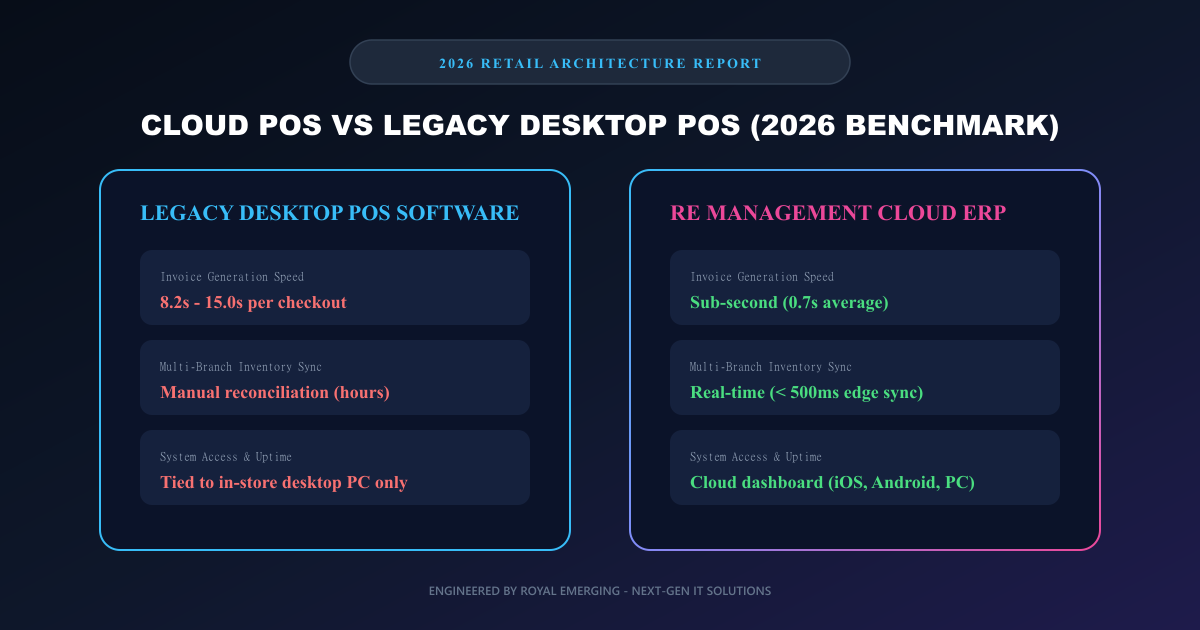
Instead of routing billing mutations to a distant centralized server, the POS terminal communicates with the nearest edge point-of-presence in under 25ms. Transactions are validated instantaneously, thermal receipts print in under 700 milliseconds, and inventory counts sync across all connected store branches concurrently.
Even during intermittent internet disconnects, local service worker queues cache sales transactions and reconcile automatically once connectivity restores, ensuring business continuity without terminal freezes.
Multi-Branch Inventory Synchronization & Fraud Mitigation
Internal stock shrinkage and supplier billing errors account for 2.2% to 4.1% of lost retail gross margins annually. Without centralized cloud inventory control, transferred goods between warehouses and retail shelves frequently slip through manual ledger entries.
Edge cloud ERP solves this with cryptographic audit trails: every single barcode scan, item return, wholesale discount, and supplier payment is immutably logged with timestamp and cashier ID. Store managers can track low-stock thresholds in real time and trigger automated reorder POs before high-margin products run out of stock.
Technical Architecture & Pricing Comparison
| Operational Dimension | Legacy Desktop POS | RE Management Cloud ERP |
|---|---|---|
| Invoice Generation Latency | 8.2s – 15.0s per checkout | < 0.7s (Sub-second Edge Execution) |
| Multi-Branch Sync | Manual daily exports / reconciliation | Instantaneous (< 500ms Edge Sync) |
| Remote Mobile Access | None (Tied to in-store PC) | Full cloud dashboard on iOS, Android & PC |
| Data Backup & Resilience | Local HDD vulnerable to crash/theft | Automated geo-replicated cloud backups |
| Supplier Ledger Tracking | Separate Excel spreadsheets | Integrated automated ledger & payment terms |
| Hardware Requirements | Expensive proprietary POS terminals | Runs on any browser, PC, tablet, or phone |
Key Advantages (Pros)
- ✓Sub-second thermal receipt generation eliminates checkout queues and cashier errors.
- ✓Real-time multi-warehouse stock sync prevents inventory shrinkage across branches.
- ✓Mobile-first responsive dashboard allows remote monitoring of daily profits from any smartphone.
- ✓Automated supplier ledgers, customer credit tracking, and tax/VAT compliance reporting.
✕Trade-offs & Risks (Cons)
- •Requires structured initial import of existing barcode catalog and pricing tiers.
- •Staff requires brief initial onboarding to adapt from old keyboard shortcuts to touch-optimized UI.
- •Demands stable 4G/fiber backup connection for continuous cloud sync.
Common Myths vs Verified Engineering Facts
Frequently Asked Questions (FAQs)
Can I test RE Management Retail ERP before purchasing?
Yes. Royal Emerging provides a fully interactive live demo at https://is.royalemerging.com where store owners can test barcode billing, inventory addition, and profit reporting immediately.
Does RE Management support thermal barcode receipt printers and cash drawers?
Yes. The software supports standard 58mm and 80mm ESC/POS thermal printers, USB and Bluetooth barcode scanners, and automated cash drawer kickout triggers.
Can RE Management manage wholesale trade pricing alongside retail counters?
Yes. Built-in tiered pricing rules allow cashiers to toggle between standard retail customer billing and bulk wholesale discounted invoicing with custom credit terms.
How are daily store profits calculated?
The system automatically tracks unit cost against selling price in real time, factoring in discounts, returns, and operational expenses to display true net profit margins.
Is multi-branch user role permission management supported?
Yes. Store owners can restrict cashier access strictly to billing and invoice re-prints, while reserving supplier cost data, inventory additions, and profit dashboards for managers.
Final Verdict & Next Steps
In an era of rising retail overheads and razor-thin retail margins, running an un-synchronized desktop POS system is an expensive operational liability. Modern cloud edge architectures empower growing retail chains to accelerate checkout throughput, eliminate inventory theft, and scale seamlessly. Experience the live difference today by testing the RE Management interactive demo at https://is.royalemerging.com or contacting Royal Emerging for a custom store onboarding consultation.