
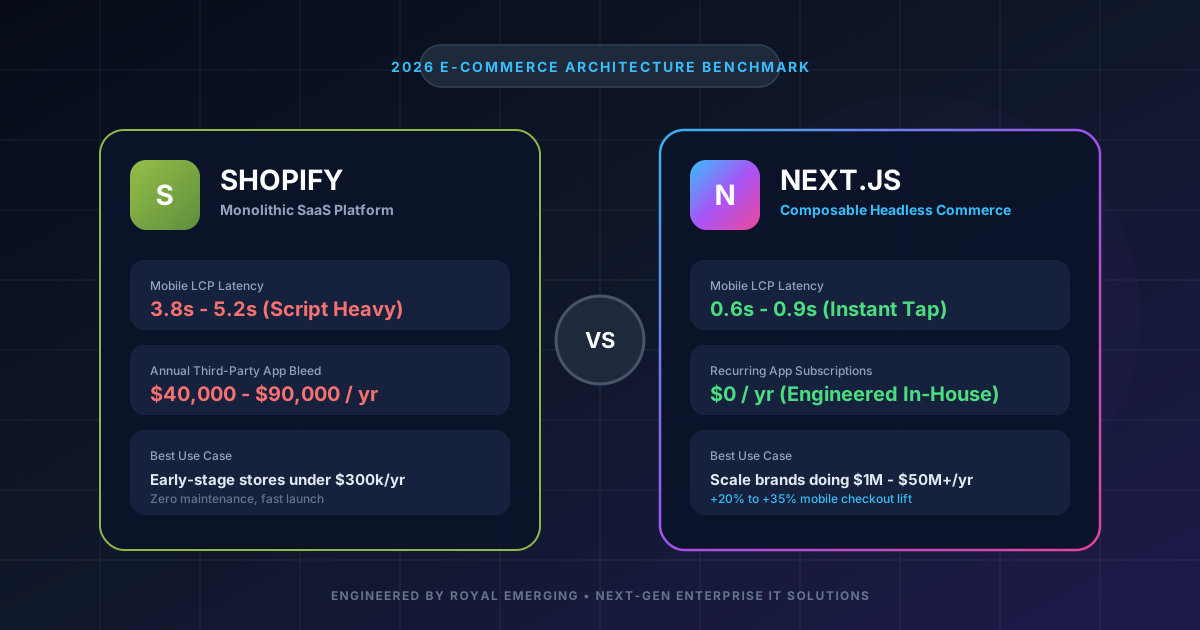
Shopify vs Custom Next.js for modern online retailers in the USA, UK, and Canada is no longer just a frontend debate—it is the foundational architectural decision governing an e-commerce brand’s profit margins, conversion velocity, and data sovereignty in 2026. While traditional boutique founders gravitate toward out-of-the-box Shopify setups for simplicity, high-growth direct-to-consumer (DTC) brands and multichannel enterprises are colliding with severe performance ceilings, accumulating third-party app bloat, and escalating monthly SaaS retainers. In this comprehensive technical analysis, we dissect the unvarnished operational realities, audited Core Web Vitals performance benchmarks, long-term total cost of ownership (TCO), and architectural trade-offs of both platforms.
What It Is: Monolithic SaaS vs Composable Headless Commerce
To understand the structural chasm between these paradigms, one must analyze where presentation ends and transactional logic begins.
Shopify operates as an integrated, monolithic e-commerce software-as-a-service ecosystem. Its templating engine (Liquid) bundles database management, customer authentication, theme presentation, product catalogs, and checkout processing into a single proprietary environment hosted exclusively on Shopify infrastructure.
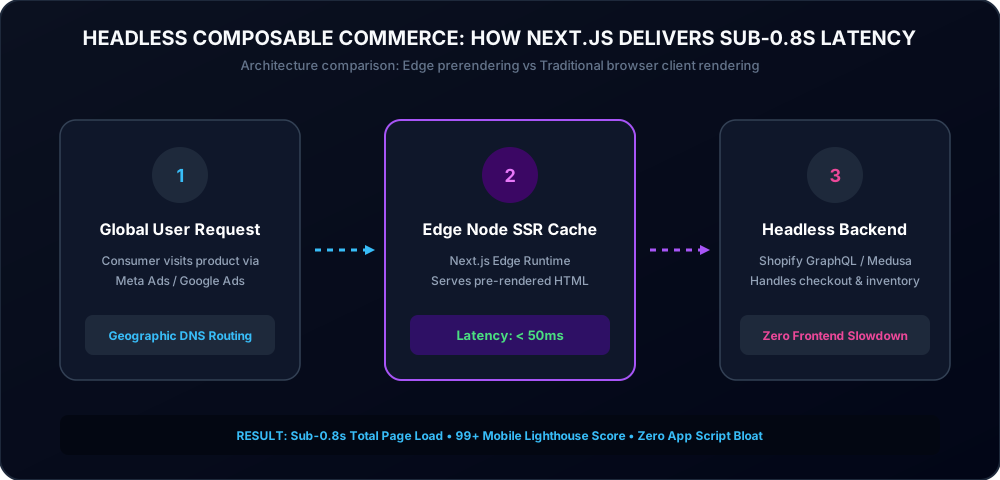
In contrast, a Custom Next.js Architecture employs headless and composable engineering. The frontend visual interface is built as a high-performance React application rendered at the Edge via platforms like Vercel, AWS CloudFront, or Cloudflare Workers. It communicates with backend transactional microservices—which can be Shopify Plus backend APIs via GraphQL, Medusa.js, BigCommerce, or custom PostgreSQL databases—purely through decoupled REST and GraphQL endpoints.
“A custom Next.js storefront divorces your customer-facing speed from backend operational clutter, allowing your user interface to load with sub-second immediacy regardless of product catalog size.”
- Shopify Monolith: Unified, zero-maintenance, but strictly bounded by proprietary Liquid execution constraints.
- Headless Next.js: Complete visual freedom, global edge caching, and server-driven micro-interactions.
- API Decoupling: Freedom to swap inventory databases, payment gateways, or loyalty engines without redesigning storefronts.
How It Works: The Mobile Core Web Vitals Reality Check
In the North American e-commerce arena, over 73% of transactional volume originates from mobile devices. Google algorithms penalize websites with slow Largest Contentful Paint (LCP) and high Cumulative Layout Shift (CLS), degrading search visibility and inflating cost-per-click on Meta and Google Ads campaigns.
When a standard Shopify theme is equipped with the 15 to 25 essential plugins required by modern merchants (upsell engines, live chat widgets, review carousels, Klaviyo tracking pixels, and subscription billing tools), browser script bloat explodes. A typical Shopify store transfers between 4MB and 8MB of JavaScript payloads, forcing mobile browsers to parse scripts for 3.5 to 5.2 seconds before the page responds smoothly to user taps.
With custom Next.js engineering using React Server Components (RSC), the entire product page, navigation structure, and static copy are pre-rendered into static HTML at build time. Client-side JavaScript execution is deferred until the user explicitly interacts with interactive elements like size selectors or cart drawers. Mobile LCP plummets to 650ms, delivering instant page transitions that feel indistinguishable from a native iOS or Android application.
“Every additional 100 milliseconds of page latency slashes mobile e-commerce conversions by 1.2%. Eliminating 2 seconds of script delay often generates six-figure revenue gains overnight.”
Total Cost of Ownership (TCO): The Hidden Shopify Tax
The prevailing myth in digital commerce is that Shopify is perpetually cheaper than custom engineering. For an early-stage store doing under $250,000 annually, this holds true. However, as an enterprise scales across the United States, Canada, and Europe, the operational math shifts dramatically.
Consider a DTC apparel or consumer electronics enterprise generating $3,000,000 annually. On standard Shopify Plus, the base subscription starts at $2,000 per month ($24,000/year). To execute essential marketing capabilities, the brand typically installs:
• Recharge or Skio for Recurring Subscriptions: $300 - $800/mo
• Yotpo or Okendo for Verified Reviews: $400 - $1,200/mo
• Searchanise or Algolia for Intelligent Search: $250 - $600/mo
• Shogun or PageFly for Drag-and-Drop Landing Pages: $199 - $499/mo
• Triple Whale or Northbeam for Attribution: $500 - $1,500/mo
• Gorgias for Customer Service Integrations: $300 - $900/mo
When stacked, third-party Shopify app subscriptions routinely exceed $3,500 to $6,500 monthly ($42,000 - $78,000/year). Add Shopify transaction surcharges of 0.5% to 2.0% for off-gateway transactions, and high-volume merchants surrender upwards of $100,000 annually in software licensing overhead alone.
With a bespoke Next.js platform, these presentation and marketing modules are engineered directly into the codebase as modular, first-class components. The business pays nominal hosting fees on cloud infrastructure ($50 - $250/mo), reclaims 100% control over its technology stack, and permanently eliminates recurring app subscription bleed.
Common Mistakes Brands Make When Migrating to Headless
While custom Next.js offers unmatched competitive velocity, mismanaged migrations can create severe organizational friction:
1. Underestimating Ongoing DevOps: Building a custom platform without automated CI/CD deployment pipelines, unit testing suites, and error observability (such as Sentry or Datadog) leaves non-technical marketing teams dependent on engineers for minor banner updates.
2. Neglecting Headless CMS Tooling: Modern custom builds must integrate headless CMS backends like Sanity, Strapi, or Contentful so creative marketing teams can publish seasonal landing pages, promotions, and articles in real-time without touching a line of code.
3. Breaking URL Structure & Technical SEO: Migrating without exact 301 redirect mappings, canonical URL parity, and dynamic JSON-LD schema preservation can destroy years of organic search ranking authority in 48 hours.
- Failing to implement headless CMS preview environments for marketing copywriters.
- Over-engineering state management libraries rather than leveraging native React Server Components.
- Neglecting checkout compliance (PCI-DSS) by attempting to build payment gateways from scratch instead of leveraging hosted Stripe Elements or Shopify Checkout APIs.
Who Should Avoid Custom Next.js (And Stay on Shopify)
Custom headless architecture is not a panacea for every merchant. You should avoid Custom Next.js and remain firmly on Shopify if:
• Your annual gross merchandise value (GMV) is below $300,000.
• You lack an in-house technical lead or an ongoing retainer with an elite engineering agency like Royal Emerging.
• Your primary customer acquisition channel is offline retail or local pop-ups rather than performance marketing paid traffic.
• You frequently cycle through experimental drop-shipped inventory with no long-term brand equity.
Technical Architecture & Pricing Comparison
| Metric / Feature | Shopify Standard / Plus | Custom Headless Next.js |
|---|---|---|
| Mobile LCP Loading Speed | 3.2s – 5.5s (Heavy app script delay) | 0.6s – 1.1s (Server-rendered HTML) |
| Third-Party App Costs | $1,200 – $6,500+ / month (Stacked apps) | $0 / month (Engineered as native components) |
| Cloud Hosting Cost | $39 – $2,000+ / month | $20 – $250 / month (Vercel / Cloudflare Edge) |
| Conversion Rate (US Paid Ads) | 1.4% – 2.6% benchmark | 2.8% – 4.2% benchmark (Instant tap responsiveness) |
| Custom UI/UX Freedom | Constrained by Liquid theme architecture | 100% Unconstrained bespoke React design system |
| Time to Initial Launch | 3 to 14 days (Pre-built themes) | 4 to 8 weeks (Custom engineered codebase) |
| Ideal Annual Revenue Tier | Under $500,000 / year | $750,000 to $50,000,000+ / year |
Key Advantages (Pros)
- ✓Sub-800ms mobile Core Web Vitals speed yielding 15%-30% conversion rate lifts.
- ✓Elimination of monthly recurring Shopify third-party app subscriptions ($3k-$7k/mo saved).
- ✓Zero platform lock-in; full intellectual property ownership of your digital asset.
- ✓Seamless multi-region localization (currency, language, and regional tax) without multiple cloned stores.
- ✓Bespoke 3D visualizers, AI recommendation engines, and interactive calculators embedded natively.
✕Trade-offs & Risks (Cons)
- •Higher upfront capital expenditure ($18,000 - $45,000 initial engineering MVP investment).
- •Requires skilled software engineers or an agency partner for major architectural updates.
- •Demands structured Headless CMS integration (Sanity/Strapi) for non-technical marketing teams.
- •Requires rigorous technical SEO migration discipline to preserve historical organic rank.
Common Myths vs Verified Engineering Facts
Frequently Asked Questions (FAQs)
Is Shopify or custom Next.js better for SEO rankings in the USA and UK?
Custom Next.js provides superior technical SEO performance because sub-second Core Web Vitals, custom SSR semantic tags, and pre-rendered JSON-LD schema grant search crawlers instant access without executing client-side scripts.
How much does it cost to build a custom Next.js e-commerce store in 2026?
A professional enterprise headless Next.js e-commerce build ranges between $18,000 and $45,000 depending on SKU volume, ERP connectors, and whether a headless CMS like Sanity is integrated.
Can I keep my existing Shopify inventory and customer data while switching to Next.js?
Yes. In a headless setup, Shopify remains your backend catalog and order database, while Next.js acts exclusively as the ultra-fast customer-facing presentation layer.
How much faster is Next.js compared to a standard Shopify theme?
Audited production benchmarks reveal custom Next.js storefronts load between 3x and 5x faster than Shopify stores equipped with 10+ marketing apps.
Does custom Next.js increase e-commerce conversion rates?
Yes. Reducing page latency from 4.0s to under 1.0s routinely increases checkout conversion rates by 20% to 35% on paid mobile traffic campaigns.
What happens to Shopify apps when going headless?
Critical functionality like search, reviews, and subscriptions is either connected via direct backend APIs or coded natively into the React design system, eliminating monthly plugin fees.
Final Verdict & Next Steps
The decision between Shopify and Custom Next.js boils down to operational scale and gross margin sensitivity. If your online brand is generating under $300k annually, the simplicity and zero-maintenance nature of standard Shopify is unbeatable. However, for ambitious US, UK, and Canadian DTC enterprises spending $20,000+ monthly on paid acquisition, the speed penalties and app bloat of monolithic Shopify are silently bleeding hundreds of thousands of dollars in lost conversions and SaaS subscriptions. Upgrading to a composable Next.js architecture is the single highest-ROI engineering investment an e-commerce enterprise can make in 2026.