
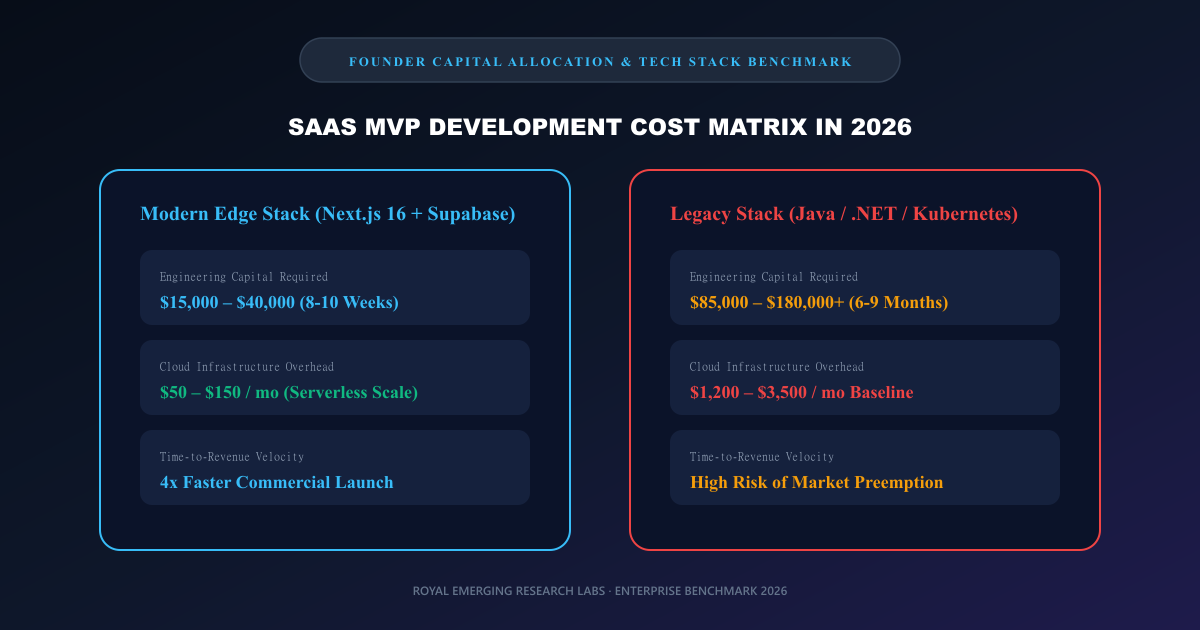
In 2026, building a software-as-a-service (SaaS) minimum viable product (MVP) is no longer about proving whether technology can solve a problem—it is about validating commercial willingness-to-pay with minimum burn and maximum velocity. With interest rates driving a laser focus on capital efficiency, startup founders and enterprise innovation labs in the United States, United Kingdom, and global tech hubs cannot afford to spend $150,000 and nine months building bloated monolithic software. In this comprehensive 2026 guide, Royal Emerging senior software architects break down the exact costs of engineering a modern SaaS MVP across discovery, frontend engineering, database tenancy, billing systems, and serverless hosting.
The True Definition of a 2026 Production-Grade SaaS MVP
A minimum viable product in 2026 is distinctly different from the "throwaway prototypes" of a decade ago. Enterprise and consumer buyers today demand sub-second page transitions, SOC 2-compliant data encryption, seamless mobile responsiveness, and frictionless Stripe self-service billing from day one.
A production MVP must achieve three core objectives: deliver the core differentiating value proposition, secure sensitive customer data with row-level security (RLS), and collect recurring revenue with zero manual intervention. Anything beyond this core loop is feature bloat that consumes precious runway.
Itemized SaaS MVP Budget Breakdown: Where the Money Goes
Phase 1: Architecture & UX Wireframing ($2,500 – $5,000) — Establishing relational entity models, multi-tenant database schemas, and high-fidelity Figma user journeys. Rushing past this phase is why 40% of startups suffer expensive architectural rewrites.
Phase 2: Full-Stack Engineering ($10,000 – $25,000) — Developing the core application using Next.js 16, TypeScript, React Server Components, and Tailwind CSS. Implementing authentication (Clerk, Supabase Auth, or NextAuth), multi-role permissions, and dashboard analytics.
Phase 3: Billing, Webhooks & Automated Workflows ($2,500 – $6,000) — Integrating Stripe Billing or LemonSqueezy with automated webhook processing for subscription tiers, invoice generation, customer billing portals, and dunning management.
Phase 4: QA, End-to-End Testing & CI/CD ($1,500 – $4,000) — Playwright integration tests, automated GitHub Actions pipelines, security vulnerability audits, and Lighthouse Core Web Vitals optimization.
Why Next.js 16 + Supabase Is the Unmatched Velocity Stack
For over 90% of web-based SaaS startups launched in 2026, the combination of Next.js 16 and Supabase provides an unbeatable balance of velocity, performance, and low operational cost.
Next.js 16 enables server-side rendering for marketing pages (essential for Google SEO and GEO indexing) while executing protected dashboard routes with instantaneous client-side interactivity. Meanwhile, Supabase provides enterprise PostgreSQL with Row-Level Security (RLS), real-time WebSockets, and automated connection pooling without the need to maintain dedicated DevOps engineers.
Hosting & Infrastructure Costs: From $50/mo to $5,000/mo
One of the greatest financial mistakes early-stage founders make is provisioning dedicated Kubernetes clusters and oversized cloud instances before acquiring their first paying customer. In 2026, serverless edge hosting allows startups to run their entire application for under $100 per month.
At Royal Emerging, we architect client platforms using serverless edge compute (Vercel, AWS Lambda, Cloudflare Workers) paired with serverless PostgreSQL (Neon, Supabase). This architecture scales from zero to 100,000 daily active users automatically with zero idle server costs.
Hiring Comparison: In-House vs Freelancer vs Dedicated Engineering Partner
Hiring an in-house full-stack software engineer in the United States or United Kingdom commands a salary of $130,000 to $175,000 per year, plus payroll taxes, equity, and healthcare. Building a three-person team costs upwards of $400,000 before writing a single line of code.
Hiring disconnected freelancers on platforms like Upwork often results in fragmented architectures, conflicting coding standards, and zero architectural accountability when bugs emerge.
Engaging a specialized engineering consultancy like Royal Emerging provides a dedicated squad of senior software architects, frontend engineers, and cloud specialists for a fixed, predictable budget (saving 50% to 60% compared to onshore engineering) with 100% intellectual property transfer.
Common Myths vs Verified Engineering Facts
Frequently Asked Questions (FAQs)
How long does it take to develop a SaaS MVP in 2026?
A focused, production-grade SaaS MVP typically takes between 8 and 12 weeks from initial wireframes to production launch on modern edge cloud infrastructure.
How can I calculate an accurate price estimate for my software project?
You can use Royal Emerging free Web Development Cost Calculator (https://royalemerging.com/tools/cost-calculator) to get an immediate, itemized cost estimate across design, backend, auth, and database requirements.
Does Royal Emerging help founders build and scale SaaS products?
Yes. Royal Emerging architects, builds, and maintains custom Next.js web applications, multi-tenant SaaS platforms, and cloud infrastructure for startups and global enterprises. Contact info@royalemerging.com to schedule a discovery session.
Final Verdict & Next Steps
Building a successful SaaS in 2026 requires ruthless prioritization, modern edge-native architecture, and disciplined capital allocation. By focusing on your core unique value proposition and choosing battle-tested ecosystems like Next.js 16 and managed PostgreSQL, you can launch a resilient, high-converting product in under 90 days. Explore Royal Emerging free tools or book an architectural consultation with our senior engineers today.