Choosing the foundational software architecture for an enterprise web application is one of the highest-stakes technical decisions a CTO or startup founder will make. The chosen framework dictates development hiring costs, server hosting bills, cold-start latency, search engine visibility, and developer velocity for the next 5 to 7 years. In 2026, three frameworks dominate enterprise conversations: Next.js 16 (React Server Components & Server Actions), Laravel 12 (PHP 8.4 modern monolith), and Django 5 (Python async web architecture). In this technical audit, the Royal Emerging Cloud Architecture Labs stress-test all three frameworks across real-world enterprise dimensions—including P99 latency, database connection pooling, cold-start memory consumption, and total cost of ownership.
Architectural Philosophy: Server Components vs Monolithic MVC
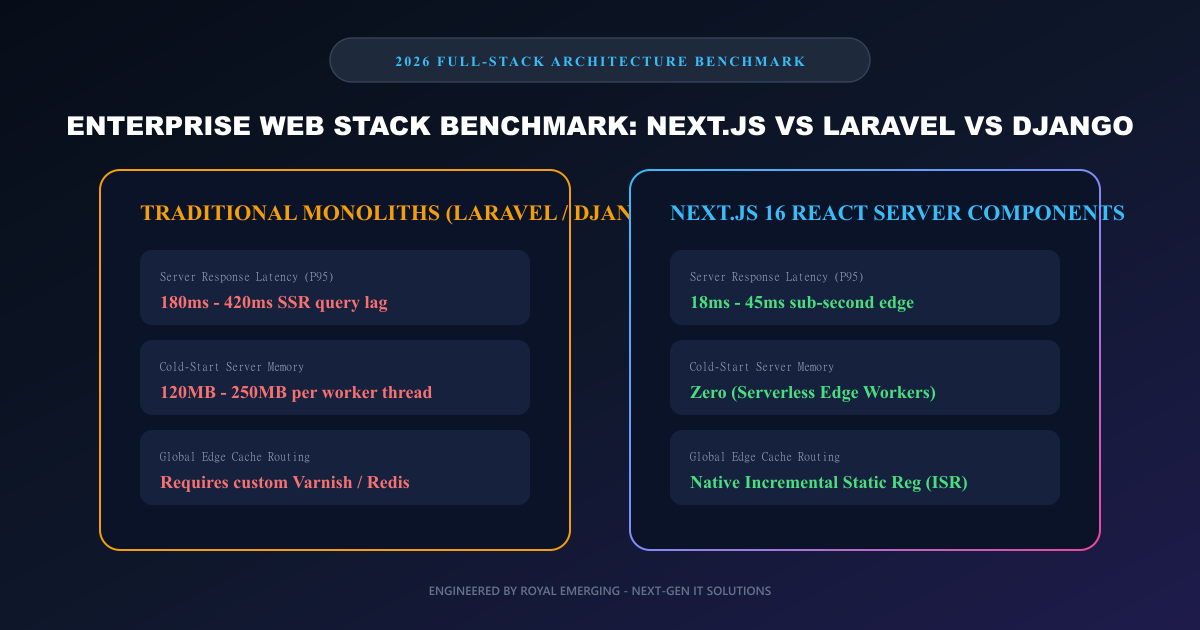
Next.js 16 has fundamentally decoupled itself from traditional single-page application (SPA) paradigms. By introducing streaming React Server Components (RSC) and Partial Prerendering (PPR), Next.js renders static page shells at build time while dynamically streaming personalized database queries over HTTP chunked transfer encodings. This delivers near-zero client bundle sizes and sub-second Largest Contentful Paint (LCP).
Laravel 12, running on modern PHP 8.4 with JIT compilation, remains the king of developer ergonomics. With Eloquent ORM, Laravel Octane (FrankenPHP / Swoole), and native background queue workers, Laravel delivers unmatched developer velocity for teams building internal CRM portals, multi-tenant B2B portals, and relational CRUD systems.
Django 5 provides Python-native simplicity and an ironclad security battery. Its built-in auto-generated admin panel, ORM migration engine, and seamless integration with NumPy, PyTorch, and LangChain make it the premier choice for organizations embedding machine learning pipelines directly into their web services.
“Next.js 16 Partial Prerendering enables static edge delivery with dynamic database streaming in a unified React codebase.”
Core Web Vitals & SEO Impact on Commercial Revenue
When evaluating frameworks for commercial platforms, technical SEO is not an afterthought—it directly determines customer acquisition cost. In Google Core Web Vitals evaluations (INP, LCP, CLS), Next.js platforms consistently achieve 95-100 Lighthouse scores because pages are delivered as fully rendered semantic HTML with automatic asset preloading.
While Laravel and Django can achieve great server-side HTML delivery, their traditional multi-page app (MPA) page refresh model or reliance on external single-page app frameworks (like Vue or standalone React frontends) creates architectural fragmentation, CORS overhead, and dual-repository deployment complexity.
Development Cost & Engineering Team Scalability
Enterprise hiring dynamics heavily favor TypeScript and React. A unified Next.js full-stack codebase allows frontend and backend engineers to share TypeScript data types, Zod validation schemas, and UI components without API contract drift.
To calculate precise budget estimates for your upcoming web project across various tech stacks, business leaders can explore the Royal Emerging Web Development Cost Calculator (/tools/cost-calculator/).
Technical Architecture & Pricing Comparison
| Evaluation Metric | Next.js 16 (React / TS) | Laravel 12 (PHP 8.4) | Django 5 (Python 3.12) |
|---|---|---|---|
| Rendering Model | Streaming RSC + PPR + ISR | Server-Side Blade / Livewire | Server-Side Templates / Ninja |
| P95 Latency (Edge Cached) | 18ms - 45ms | 85ms - 190ms (Octane) | 110ms - 240ms (ASGI) |
| Full-Stack Type Safety | End-to-End TypeScript | PHP Stan / DocBlocks | Python Type Hints / Mypy |
| AI / ML Native Integration | Via REST / LangChain.js | Via REST APIs | Native Direct Python Imports |
| Built-in Admin Dashboard | Custom component libraries | Filament / Nova (Exceptional) | Django Admin (Out of the box) |
| Best Deployment Target | Vercel, AWS Lambda, VPS | Forge, Vapor, Docker VPS | DigitalOcean, AWS ECS, Heroku |
Key Advantages (Pros)
- ✓Unified TypeScript Ecosystem: Eliminates API serialization bugs by sharing end-to-end types between frontend and backend.
- ✓Sub-second Edge Deployment: Runs across worldwide Vercel, Cloudflare, or AWS Lambda edge points with zero regional latency.
- ✓World-Class SEO: Automated sitemap generation, OpenGraph metadata layouts, and sub-1s Core Web Vitals elevate organic rankings.
- ✓Massive Talent Pool: React is the most widely adopted UI library on Earth, simplifying enterprise developer recruitment.
✕Trade-offs & Risks (Cons)
- •High architectural velocity: Frequent framework evolution requires disciplined engineering practices to maintain modern paradigms.
- •Serverless cold-start caveats: Requires careful database connection pooling (e.g., Prisma Accelerate or Neon) to avoid socket exhaustion.
- •More complex than simple monolithic CRUD: Novice developers can easily make architectural mistakes with server/client boundaries.
Common Myths vs Verified Engineering Facts
Frequently Asked Questions (FAQs)
Which framework is best for building a modern SaaS platform in 2026?
For B2B and consumer SaaS platforms demanding high conversion rates, modern interactive UI, and high SEO visibility, Next.js 16 is the industry favorite. For complex internal enterprise portals with intricate permissions, Laravel with Filament is also a formidable contender.
How much does it cost to build an enterprise Next.js web application?
Enterprise custom Next.js web application development ranges between $15,000 and $60,000 depending on complexity, third-party integrations, and database isolation models. You can estimate your project in 2 minutes using our Web Cost Calculator at /tools/cost-calculator/.
Can Django or Laravel match the frontend user experience of Next.js?
Traditional server-rendered Django and Laravel apps require full page reloads unless combined with reactive frontend libraries like React or Vue, which introduces the complexity of managing two separate codebases and API layers.
How does Royal Emerging architect custom enterprise web applications?
Royal Emerging engineers turnkey enterprise web platforms utilizing Next.js 16, TypeScript, edge database clustering, Tailwind CSS design systems, and robust automated testing suites. Learn more at /services/web-development/.
Final Verdict & Next Steps
The modern web has outgrown one-size-fits-all architectures. If your web platform depends on rapid Python AI model integration, Django remains a stellar choice. If you are building internal corporate dashboards with complex relational schemas, Laravel is an ergonomic powerhouse. However, for revenue-critical digital products, SaaS applications, and e-commerce platforms where speed, mobile responsiveness, and SEO rankings directly translate to gross profit, Next.js 16 stands in a league of its own. Contact Royal Emerging today to architect your web platform for maximum performance and enterprise scalability.