Mobile App Development Cost in the USA, UK, and Canada is one of the most widely searched and frequently obscured investment figures in enterprise technology today. Non-technical founders and enterprise product managers are routinely presented with wildly disparate quotes ranging from $10,000 from amateur freelancers to $250,000+ from legacy agency firms. In 2026, the proliferation of high-performance cross-platform frameworks, serverless mobile backends, and pre-built authentication services has fundamentally rewritten the economics of mobile software engineering. In this definitive guide, we provide an unvarnished, line-item pricing audit detailing exactly where development dollars are spent and how to launch an enterprise-grade mobile product without budget overrun.
Average Mobile Development Costs by Complexity Tier in 2026
Mobile engineering budgets are governed strictly by functional complexity, real-time data synchronization requirements, and regulatory compliance standards:
1. Stage 1: MVP / Proof of Concept ($20,000 - $35,000): Features user authentication (Apple, Google, Email), profile management, core utility screens, basic push notifications, and a clean Stripe or In-App Purchase integration. Timeline: 6 to 9 weeks.
2. Stage 2: Commercial Scale Mobile Application ($40,000 - $75,000): Includes real-time chat, geolocation and interactive mapping, offline local SQLite synchronization, dynamic media feeds, role-based administration, and automated analytics telemetry. Timeline: 10 to 16 weeks.
3. Stage 3: Enterprise & FinTech / HealthTech Platform ($80,000 - $180,000+): Demands biometric multi-factor authentication, end-to-end encrypted messaging, automated regulatory audit logging (HIPAA / SOC 2), multi-region high availability, and legacy core database sync. Timeline: 18 to 28 weeks.
“The single most costly mistake in mobile development is writing two separate native codebases for a consumer MVP before validating product-market fit.”
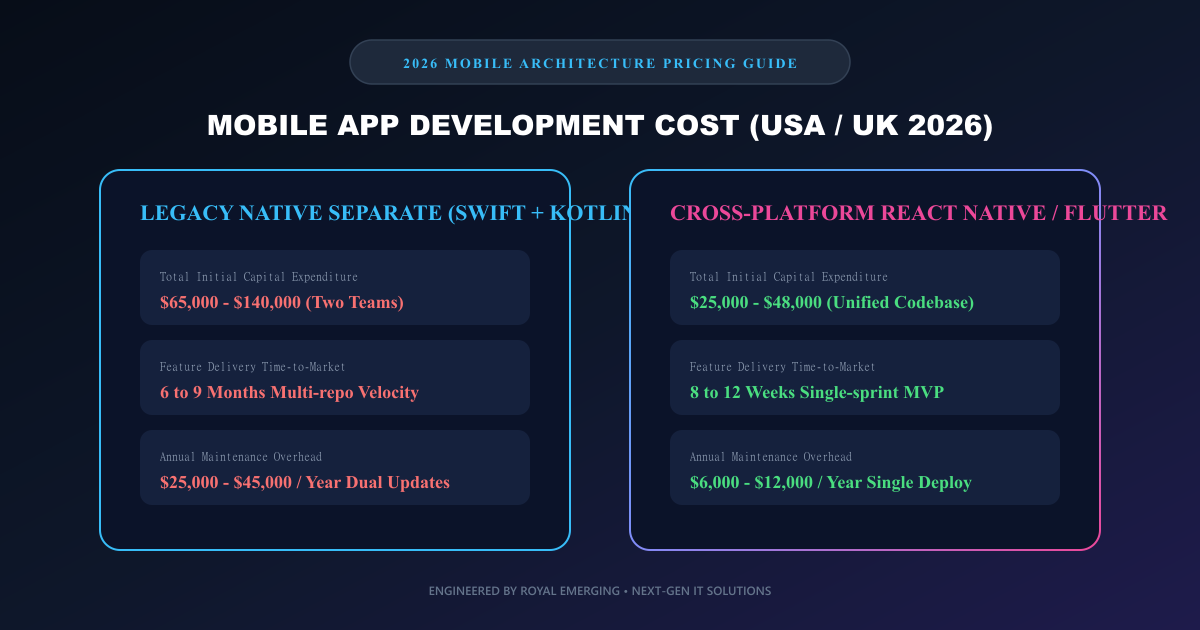
Native (Swift & Kotlin) vs Cross-Platform (React Native & Flutter)
For over a decade, engineering conventional wisdom dictated building separate native iOS apps in Swift and native Android apps in Kotlin. In 2026, this approach is almost exclusively reserved for low-level Bluetooth hardware drivers, AAA mobile gaming, or heavy 3D augmented reality.
For 92% of business, SaaS, social, and e-commerce applications, modern React Native (with the New Architecture fabric renderer) and Flutter deliver 60-to-120 FPS performance virtually indistinguishable from native code. Building with React Native allows our engineers to share up to 90% of business logic across iOS, Android, and web platforms, slashing delivery costs by 45% and halving post-launch bug triage overhead.
Hidden Costs That Surprise First-Time App Founders
Securing your development quote is only the first phase of mobile budgeting. Budgeting must account for ongoing operational commitments:
• Developer Accounts: Apple Developer Program ($99/yr) and Google Play Console ($25 one-time fee).
• Cloud Backend & Database Hosting: AWS, Supabase, or Firebase ($50 - $400/month initial scale).
• Push Notification & Analytics Infrastructure: OneSignal and Mixpanel ($100 - $350/month).
• Mandatory OS Update Maintenance: Apple and Google release major OS updates annually (iOS 19 / Android 16) requiring dependency upgrades and deprecated API patches ($4,000 - $10,000 annually).
Technical Architecture & Pricing Comparison
| Feature / Aspect | Cross-Platform (React Native) | Native (Separate Swift & Kotlin) |
|---|---|---|
| Average MVP Cost (USA/UK) | $22,000 – $45,000 | $55,000 – $110,000 |
| Development Timeline | 6 to 10 Weeks | 14 to 22 Weeks |
| Codebase Reusability | 85% – 95% unified code | 0% (Completely separate codebases) |
| UI Performance (60+ FPS) | Indistinguishable from native | Native benchmark |
| Maintenance Overhead | Single team, single sprint patches | Two distinct engineering teams required |
| Ideal Project Fit | SaaS, DTC, Marketplaces, B2B | AAA Mobile Games, Hardware Bluetooth Drivers |
Key Advantages (Pros)
- ✓High user retention: Push notifications deliver 3x to 5x higher engagement than mobile web.
- ✓Offline capabilities and native device access (Camera, Biometrics, GPS, Accelerometer).
- ✓Monetization advantages through frictionless Apple Pay and Google In-App Subscriptions.
- ✓Defensible brand equity and presence on global App Store real estate.
✕Trade-offs & Risks (Cons)
- •Higher upfront capital expenditure than standard responsive web platforms.
- •Strict App Store review guidelines and 15% to 30% digital transaction commissions.
- •Mandatory ongoing maintenance to satisfy annual Apple & Google store policy changes.
Common Myths vs Verified Engineering Facts
Frequently Asked Questions (FAQs)
How long does it take for Apple and Google to approve a new mobile app?
Apple App Review typically takes 24 to 48 hours, while Google Play review takes between 1 and 3 days for established developer accounts.
Do I own the source code and intellectual property after development?
Yes. At Royal Emerging, our contracts explicitly grant clients 100% full intellectual property and source code ownership upon milestone delivery.
Can my mobile app share the same database and API as my website?
Yes. We architect centralized REST and GraphQL backends that serve your Next.js web application and mobile apps simultaneously, ensuring instantaneous data sync.
What is the best tech stack for a startup mobile app in 2026?
The prevailing standard is React Native (TypeScript) paired with a Supabase or Node.js backend hosted on AWS, offering optimal velocity, performance, and scaling headroom.
How much does ongoing app maintenance cost annually?
Industry standard mobile maintenance ranges between 15% and 20% of your initial development budget per year to cover OS updates, security patches, and library upgrades.
Final Verdict & Next Steps
Building a market-defining mobile application in 2026 requires strategic architectural planning, disciplined MVP scoping, and an engineering partner committed to scalable code quality. Schedule a free mobile architecture consultation with Royal Emerging to review your technical roadmap and receive a fixed-price delivery proposal.