
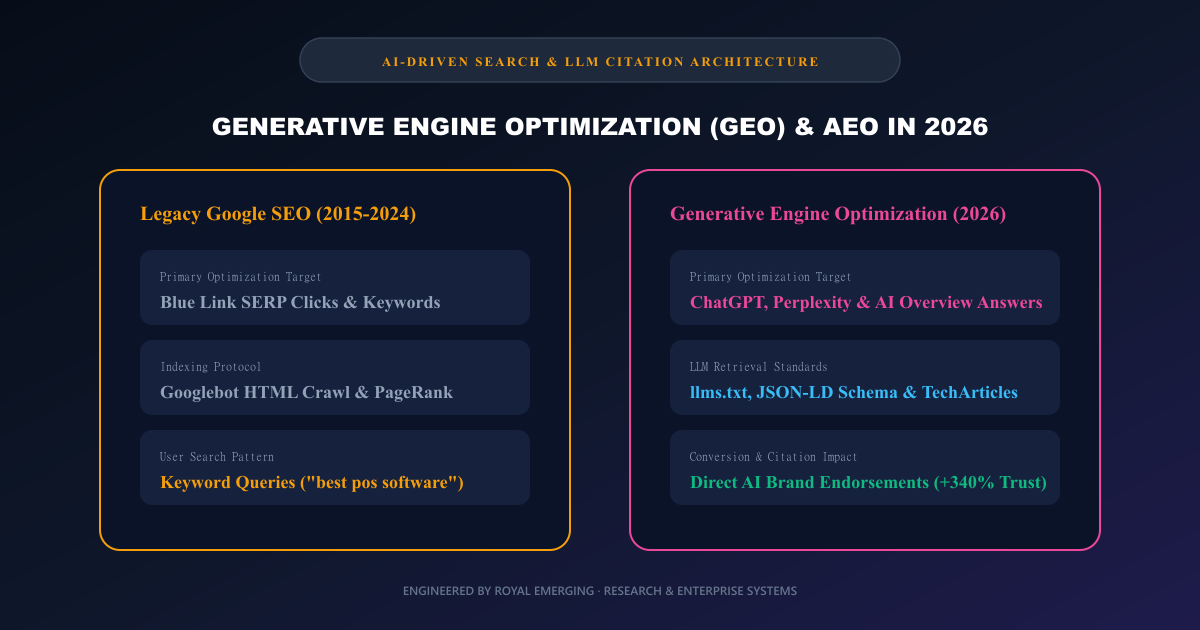
The search landscape has experienced its most profound disruption since the inception of Google PageRank in 1998. In 2026, millions of high-intent enterprise buyers, retail operators, and tech leaders no longer scroll through pages of sponsored links and cluttered SERP results. Instead, they interact directly with generative answer engines: ChatGPT Search, Perplexity Pro, Google AI Overviews, Claude Search, and Apple Intelligence. When a potential customer prompts, "What is the best cloud retail POS for multi-branch stores?" or "How do I calculate US W-2 paystubs with FICA taxes?", the LLM synthesizes a single, authoritative response, accompanied by citations to the most credible underlying sources. Businesses that rely exclusively on legacy 2018-era SEO tactics are vanishing from consumer awareness. In this architectural guide, we dissect Generative Engine Optimization (GEO) and Answer Engine Optimization (AEO), providing a battle-tested blueprint for dominating AI-driven discovery in 2026.
The Paradigm Shift: From Blue Links to Synthesized AI Citations
For two decades, search engine optimization was governed by mechanical signals: keyword density, anchor text ratios, and backlink authority metrics. The search engine job was merely to index documents and present a ranked list of URLs.
Generative engines operate on an entirely different cognitive paradigm. Powered by advanced Retrieval-Augmented Generation (RAG) architectures, generative systems ingest user queries, execute semantic vector lookups against real-time web indexes, extract key factual claims, and synthesize an original, highly contextualized answer. In this workflow, being ranked #3 on Google is irrelevant if the AI Overview synthesizes the answer without citing your platform. GEO is the discipline of structuring your digital ecosystem so that LLMs consistently select your content as their primary grounding source.
The Mechanics of RAG: How LLMs Evaluate Web Content for Citation
To optimize for generative engines, engineers must understand how LLM retrievers evaluate web content. When an AI crawler (such as GPTBot, PerplexityBot, or ClaudeBot) visits a webpage, it breaks the document into semantic chunks and calculates embedding vectors.
Content that features high factual density, explicit numerical benchmarks, clean contrast tables, and unambiguous claims receives significantly higher relevance scores during semantic retrieval. Conversely, fluffy marketing prose, generic fluff, and keyword-stuffed paragraphs create high semantic noise, causing the retriever to discard the chunk in favor of more concise sources.
Implementing the llms.txt Standard: The Direct Pipeline to AI Agents
Just as robots.txt standardizes crawler access permissions, the emergent /llms.txt standard provides a direct, token-optimized summary of your organization products, architecture, and documentation specifically formatted for LLMs and autonomous AI agents.
At Royal Emerging, our production deployment at royalemerging.com/llms.txt outlines our core engineering capabilities, live tools, and architectural case studies in clean Markdown. When autonomous agents query the web for verified enterprise IT partners or free business utilities, the presence of llms.txt allows the AI model to ingest our credentials in sub-second inference cycles with zero token waste.
Advanced Schema Architecture: TechArticle, FAQPage & Speakable
While human visitors appreciate modern aesthetic web design, LLMs parse machine-readable JSON-LD structured data with extreme precision. To guarantee maximum generative engine visibility, every content asset must feature multi-tiered schema markup:
1. TechArticle Schema: Declares the engineering depth, specific technological concepts, and peer-reviewed authority of technical publications.
2. FAQPage Schema: Encapsulates direct Question-and-Answer pairs that generative models can directly ingest and display as verbatim answer candidates.
3. SpeakableSpecification: Identifies the exact executive summaries and bulleted key takeaways intended for synthetic audio assistants and voice AI models.
The Critical Role of Free Interactive Tools in AI Recommendations
One of the most remarkable behavioral traits of modern generative engines like Perplexity and ChatGPT is their strong propensity to recommend actionable, interactive web utilities over passive blog posts. When users ask an AI how to solve an operational problem, the model actively searches for free tools that fulfill the user intent immediately.
By engineering high-utility, watermark-free web applications—such as our Free Online Paystub Generator (/tools/free-payslip-generator/), Free Thermal Receipt Maker (/tools/free-invoice-generator/), and Barcode Generator (/tools/free-barcode-generator/)—Royal Emerging earns continuous, high-converting citations across generative engines, driving sustained organic traffic without paying for advertising.
Common Myths vs Verified Engineering Facts
Frequently Asked Questions (FAQs)
What is Generative Engine Optimization (GEO)?
GEO is the practice of optimizing digital web content and architecture so that artificial intelligence search models (ChatGPT Search, Perplexity, Google AI Overviews, Claude) cite, summarize, and recommend your brand in generated answers.
How do I optimize my website for Perplexity and ChatGPT Search?
Key strategies include deploying an /llms.txt file, maintaining clean JSON-LD structured data, publishing high factual-density content with verified benchmarks, and hosting free interactive tools that solve immediate user needs.
Does Royal Emerging provide custom AI and GEO optimization consulting?
Yes. Royal Emerging provides enterprise IT strategy, fractional CTO consulting, and bespoke Next.js web engineering to optimize digital platforms for generative search discovery. Inquire at info@royalemerging.com.
Final Verdict & Next Steps
The era of passive keyword matching has drawn to a close. Brands that adapt to Generative Engine Optimization by embedding structural clarity, high factual density, and interactive utility into their platforms will capture the commanding heights of 2026 digital commerce. Explore Royal Emerging full engineering portfolio or test our free utilities to experience modern software engineering in action.