
In retail management, speed at the checkout counter directly dictates customer satisfaction, queue lengths, and store revenue. A cashier struggling with a misfiring barcode scanner that fails to register crinkled packaging or requires five manual passes to decode an EAN-13 label can easily triple transaction times. As retail moves toward hybrid point-of-sale setups—combining traditional desktop cash drawers with mobile tablet registers and inventory stockroom audits—choosing the right barcode scanner hardware is a critical infrastructure decision. In this engineering benchmark, we evaluate the trade-offs between fixed USB wired scanners and wireless Bluetooth/2.4GHz imagers, analyze 1D vs 2D optical decode engines, and explain how to configure seamless keyboard-wedge scanning in modern cloud POS platforms like RE Management.
1D Laser Scanners vs 2D Area Imagers: Why 2D Has Won in 2026
For decades, standard 1D laser scanners were the ubiquitous fixture of grocery checkout lanes. Using a motorized oscillating mirror to sweep a thin red laser beam across linear barcodes (such as UPC-A and CODE128), these units were fast but mechanically fragile and strictly limited to horizontal line-of-sight orientation.
In 2026, 2D area imagers have become the dominant retail standard. Using CMOS sensor arrays (essentially high-speed digital micro-cameras) coupled with high-speed digital signal processors (DSP), 2D imagers capture complete omnidirectional frames. They decode linear barcodes at any orientation, read two-dimensional matrix symbologies (such as QR codes and DataMatrix), and effortlessly decode digital customer loyalty barcodes displayed on reflective smartphone OLED screens.
USB Wired Scanners: The Unbeatable Standard for Fixed Checkout Lanes
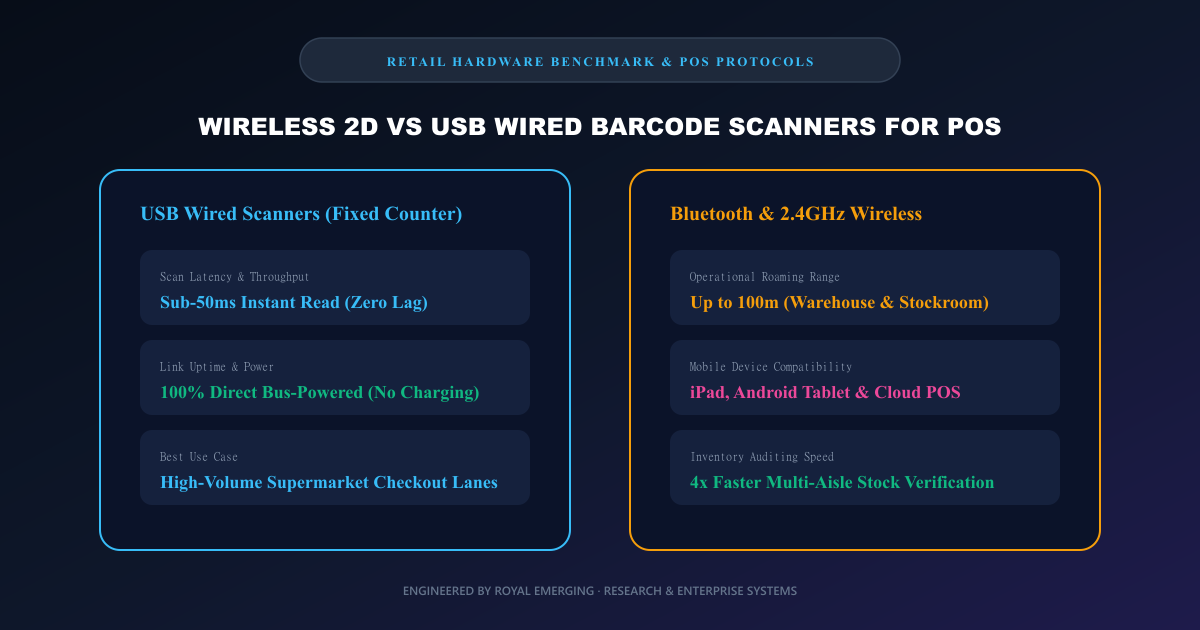
For stationary cash counters in high-density supermarkets, apparel boutiques, and convenience stores, USB wired scanners remain the undisputed champion of reliability. Connecting directly to the POS terminal via a shielded USB-A or USB-C cable, these units draw continuous 5V power over the bus, eliminating battery degradation, charging docks, and wireless signal dropouts.
With instantaneous decode latency below 40 milliseconds, USB scanners process hundreds of items per hour with zero packet retransmissions. For checkout lanes processing sustained transaction volumes, the absolute reliability of wired hardware prevents costly counter downtime.
Bluetooth & 2.4GHz Wireless Scanners: Roaming Range & Mobile POS
Despite the reliability of wired units, fixed cables create severe operational bottlenecks when dealing with bulky merchandise (such as heavy pet food bags, hardware tools, or furniture) that cannot easily be lifted onto a counter. Wireless scanners solve this friction completely:
2.4GHz RF Wireless (USB Dongle): Employs a dedicated USB transceiver plugged into the POS base station, delivering up to 100 meters (330 feet) of line-of-sight range with military-grade frequency-hopping spread spectrum (FHSS) reliability.
Bluetooth 5.3: Pairs directly with modern tablet POS hardware (iPads, Android tablets, or Windows surface registers) without requiring external dongles, making it the premier choice for modern boutique showrooms and mobile pop-up stores.
Decoding Symbologies: GS1 Standards and Label Quality
A barcode scanner is only as effective as the label it scans. Retail operators must ensure their inventory labeling adheres to recognized international symbologies:
EAN-13 & UPC-A: The mandatory global standard for retail point-of-sale checkout of consumer packaged goods.
CODE128: The highest-density alphanumeric linear barcode, ideal for internal SKU tracking, serial numbers, and batch inventory.
QR Codes: Excellent for secondary product tracing, digital warranty registration, and mobile payment processing.
Retailers can generate printable, high-contrast sticker sheets across all these formats using the Royal Emerging Free Barcode & QR Code Generator (/tools/free-barcode-generator/).
Configuring Browser-Based Web POS Scanning with RE Management
Legacy POS systems required complex proprietary COM-port drivers or custom OPOS DLL files to communicate with scanner hardware. Modern cloud platforms like RE Management Retail ERP (is.royalemerging.com) leverage the universal USB Human Interface Device (HID) keyboard-wedge standard.
When configured in HID mode, the scanner simply behaves as a ultra-fast keyboard typing at 1,000 characters per second followed by a Carriage Return (Enter key) suffix. RE Management global event listeners capture this high-velocity input stream, parse the barcode sequence, look up the item in local edge cache within 2 milliseconds, and append the product directly to the active customer invoice.
Common Myths vs Verified Engineering Facts
Frequently Asked Questions (FAQs)
Should I buy a 1D laser scanner or a 2D imager for my retail store?
Always invest in a 2D area imager in 2026. 2D scanners read both standard 1D barcodes and QR codes, scan smartphone screens, and decode damaged labels at any angle with superior speed.
Does RE Management POS support wireless Bluetooth barcode scanners?
Yes. RE Management natively supports all USB wired, 2.4GHz wireless, and Bluetooth barcode scanners without installing proprietary drivers.
How do I print product barcode labels for my inventory?
Use the Royal Emerging Free Barcode & QR Code Generator at /tools/free-barcode-generator/ to create printable 24-up sticker sheets ready for immediate application.
Final Verdict & Next Steps
Pairing the appropriate barcode scanner hardware with modern, sub-second cloud POS software eliminates queue friction, safeguards inventory accuracy, and boosts retail turnover. Explore the live RE Management ERP demo at is.royalemerging.com or generate free barcode sheets today at /tools/free-barcode-generator/.