
Architecting a modern B2B SaaS platform in 2026 requires balancing two conflicting engineering imperatives: operational cost-efficiency and absolute tenant data isolation. Early-stage startups often start with a simple shared database table with a tenant_id foreign key, only to face enterprise deal-breakers when high-value clients demand physical data segregation and SOC-2 audit guarantees. This comprehensive architecture blueprint details how to engineer production-ready multi-tenancy utilizing Next.js App Router, edge wildcard routing, and modern distributed database patterns.
Comparing Multi-Tenancy Isolation Models
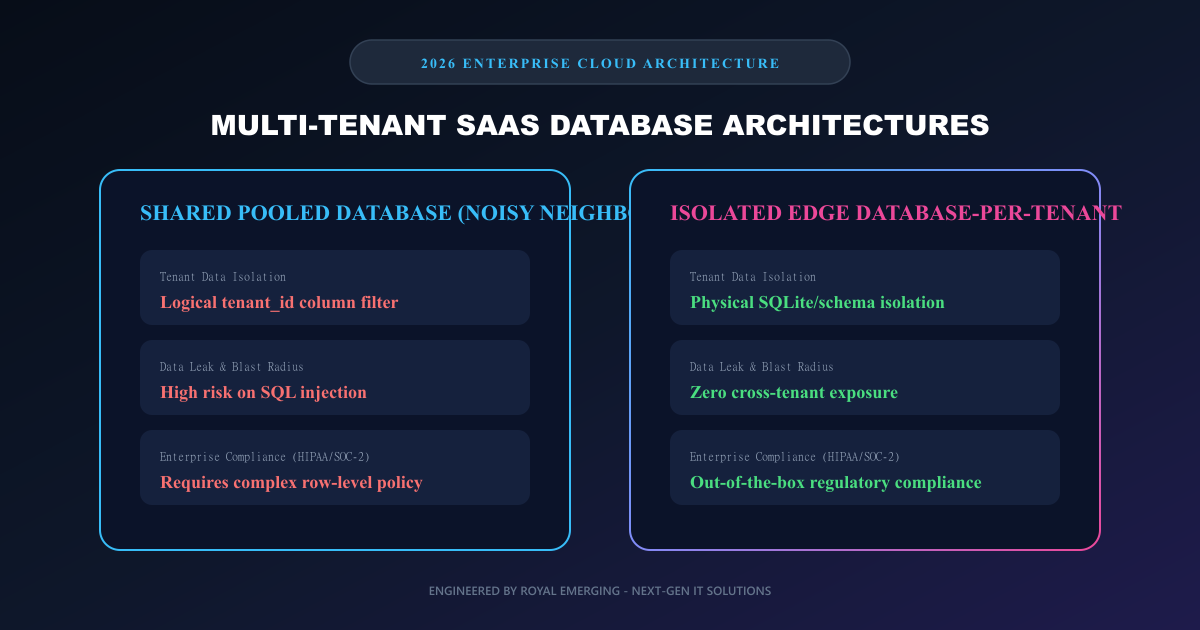
There are three primary architectures for B2B multi-tenancy: Shared Database / Shared Schema (Logical Isolation), Shared Database / Separate Schemas, and Database-Per-Tenant (Physical Isolation).
Historically, the Database-Per-Tenant model was cost-prohibitive for SaaS startups because spinning up hundreds of AWS RDS or Aurora instances incurred thousands of dollars in idle baseline compute. However, the advent of lightweight embedded edge databases like Turso (libSQL) has flipped this equation: platforms can now spin up thousands of isolated, serverless SQLite replicas on demand for fractions of a cent per tenant.
“Physical database-per-tenant isolation reduces breach blast radiuses to zero: a security compromise in Tenant A cannot leak records from Tenant B.”
Dynamic Sub-Domain Routing with Next.js Middleware
Enterprise B2B clients demand dedicated branded sub-domains (e.g., acme.yourplatform.com). In legacy architectures, configuring new sub-domains required manual NGINX reverse-proxy reloads and DNS CNAME propagation delays.
In Next.js App Router, dynamic routing is resolved at the Edge within middleware.ts: the incoming Host header is parsed, the tenant slug is extracted and validated against an edge cache (Upstash Redis or Cloudflare KV), and the internal route is rewritten instantaneously to /app/[tenant]/dashboard with zero perceptible latency.
Enterprise Compliance: SOC-2, HIPAA & Data Sovereignty
When closing Fortune 500 or healthcare SaaS deals ($20k+ ARR), security compliance checklists become the primary obstacle. Enterprise buyers explicitly prohibit their proprietary data from co-mingling in pooled database tables.
By adopting an isolated database-per-tenant architecture, compliance audits become straightforward: customer encryption keys can be individually managed, backup snapshots are tenant-specific, and meeting GDPR "Right to be Forgotten" mandates requires simply dropping that tenant’s discrete database file rather than running expensive cascading DELETE queries across hundreds of interconnected tables.
Technical Architecture & Pricing Comparison
| Architecture Dimension | Shared Pooled Database (Logical) | Isolated Edge DB-Per-Tenant |
|---|---|---|
| Tenant Data Separation | Logical (tenant_id query filter) | Physical (Discrete SQLite/libSQL files) |
| Data Leakage Risk | High (Vulnerable to developer WHERE clause bugs) | Near Zero (Physical file/credential isolation) |
| Noisy Neighbor Impact | Severe (Heavy tenant slows all users) | None (Compute and storage isolated) |
| Enterprise Compliance | Often rejected by Fortune 500 InfoSec | Meets strict SOC-2 & HIPAA mandates |
| Customer Offboarding / Deletion | Complex cascading SQL DELETE sweeps | Instantaneous (1-click database drop) |
| Cost at 1,000 Tenants | Low initial cost, complex indexing | Predictable serverless edge pricing ($0.001/tenant) |
Key Advantages (Pros)
- ✓Absolute tenant data isolation satisfies strict enterprise SOC-2, HIPAA & GDPR audits.
- ✓Eliminates the noisy neighbor problem where heavy queries from one tenant degrade platform speed for all others.
- ✓Sub-second tenant provisioning via automated edge database creation scripts.
- ✓Simplified data migration, customer backups, and instant tenant offboarding.
✕Trade-offs & Risks (Cons)
- •Requires disciplined CI/CD migration pipelines to apply database schema updates across all tenant instances concurrently.
- •Cross-tenant global reporting requires a dedicated centralized analytics replica.
- •Demands robust automated edge token management for tenant connection credentials.
Common Myths vs Verified Engineering Facts
Frequently Asked Questions (FAQs)
How do you handle schema migrations across hundreds of tenant databases?
Modern SaaS pipelines execute parallel worker pools via GitHub Actions or cloud run functions that execute SQL migration scripts across all tenant connections simultaneously, rolling back on errors.
Can tenants bring their own custom apex domain (e.g., portal.customer.com)?
Yes. Next.js middleware seamlessly inspects incoming custom domains, validates SSL certs through Vercel or Cloudflare SSL for SaaS APIs, and rewrites to that customer tenant dashboard.
How does authentication work across multiple tenant sub-domains?
We implement session tokens signed with a centralized JWT authority, passing the tenant_id in secure HttpOnly cookies scoped to the root domain or verified per-subdomain.
Is edge database-per-tenant architecture suitable for mobile applications?
Yes. Mobile applications communicate with your Next.js API route endpoints which automatically inject the appropriate tenant database connection string based on the user session token.
How can Royal Emerging help my company build a multi-tenant SaaS platform?
Royal Emerging designs and engineers complete end-to-end multi-tenant SaaS platforms, including custom Next.js frontends, edge database architectures, Stripe billing tiers, and SOC-2 compliance preparation.
Final Verdict & Next Steps
Building a scalable B2B SaaS platform requires making architectural decisions that enable growth without requiring a ground-up rewrite when enterprise buyers arrive. Adopting edge-isolated multi-tenancy gives your software the security posture, speed, and reliability demanded by modern enterprises. Contact Royal Emerging today to architect your SaaS platform for enterprise scale.