Customer contact centers in 2026 are experiencing a profound technological inflection point. For decades, scaling phone support meant expanding offshore BPO contracts, leasing cubicles, and training customer service representatives on repetitive inquiry scripts. Today, ultra-low-latency neural speech models and real-time streaming LLMs have created AI voice agents capable of fluid, emotional, and context-aware conversational phone interactions. This benchmark study examines the architectural, operational, and financial realities of replacing legacy tier-1 call center staffing with autonomous AI voice telephony.
The True Economics: $1.20 vs $0.10 Per Minute
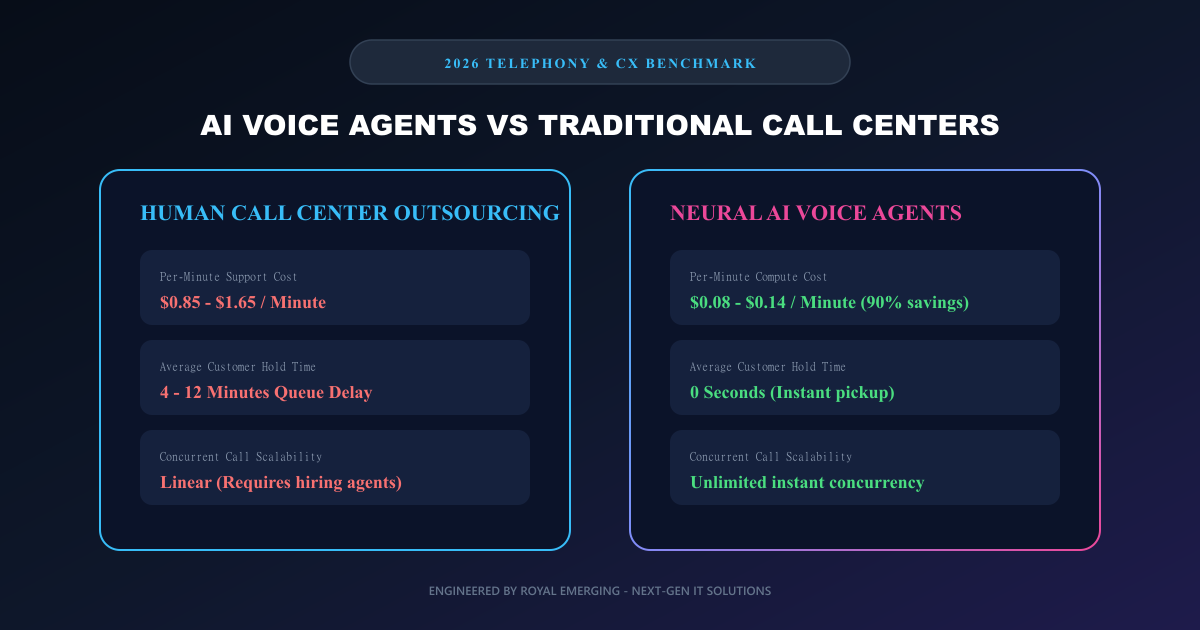
When enterprise CFOs calculate human call center costs, they often underestimate auxiliary overhead: agent attrition rates exceeding 45% annually, training cycles, healthcare benefits, and QA supervision costs drive effective blended rates to $18 - $28 per hour per agent ($0.85 - $1.65 per talk minute).
In contrast, modern AI voice telephony pipelines (utilizing streaming ASR, high-speed LLM reasoning, and neural TTS synthesis) execute at a predictable API compute cost of $0.08 to $0.14 per minute. For an enterprise handling 50,000 monthly call minutes, migrating to autonomous voice automation slashes operational outlay from $60,000 down to less than $6,500.
“Autonomous AI voice pipelines reduce inbound customer phone support expenditures by 85% to 92% while eliminating customer hold times entirely.”
Latency Engineering: Conquering the 500ms Human Conversational Threshold
The historical downfall of interactive voice response (IVR) systems was unnatural pauses and robotic cadence. Human conversational psychology perceives any conversational gap exceeding 600ms as awkward or disjointed.
State-of-the-art voice pipelines in 2026 conquer this with streaming WebSockets and speculative generation: the system transcribes user phonemes in real time (FastWhisper/Deepgram), initiates streaming LLM token generation at the first clause, and pipes audio bytes directly into low-latency neural vocoders (ElevenLabs/Cartesia) in under 420 milliseconds.
The resulting dialogue feels completely natural, responsive, and indistinguishable from a human specialist, capable of handling interruptions, background noise, and colloquial phrasing.
Dynamic CRM Integrations & Transaction Execution
Unlike static human agents who must toggle between multiple software tabs while keeping callers waiting, AI voice agents execute database function calls in parallel with dialogue. An AI voice assistant can authenticate a caller via voice biometric verification, check inventory availability in an ERP like RE Management, modify a delivery address, and charge a credit card via Stripe in under 3 seconds.
When complex emotional disputes or high-ticket VIP negotiations arise, the AI smoothly transfers the active call with complete conversation transcripts and sentiment summaries to senior human staff.
Technical Architecture & Pricing Comparison
| Performance Metric | Human Contact Center (BPO) | Autonomous AI Voice Agent |
|---|---|---|
| Cost Per Talk Minute | $0.85 – $1.65 / min | $0.08 – $0.14 / min (90% lower) |
| Average Hold Time | 4 to 12 minutes in queue | 0 seconds (Instantaneous response) |
| Concurrent Call Capacity | Limited to staffed heads | Thousands of simultaneous calls |
| 24/7/365 Availability | Overtime & graveyard shift premiums | Standard native 24/7 operation |
| CRM Data Entry Accuracy | 78% (Manual human transcription errors) | 99.8% (Automated programmatic sync) |
| Training & Onboarding | 4 to 8 weeks per agent batch | Instantaneous via prompt update |
Key Advantages (Pros)
- ✓Zero queue wait times — instant call answering regardless of inbound call surges.
- ✓Drastic 85-90% reduction in customer support and outbound telemarketing operational costs.
- ✓Perfect consistency in brand guidelines, compliance disclosures, and technical accuracy.
- ✓Automated real-time logging, CRM data sync, and sentiment analysis for every single call.
✕Trade-offs & Risks (Cons)
- •Requires custom prompt engineering and telephony SIP trunking setup.
- •Nuanced complex human empathy edge cases still require human escalation paths.
- •Initial voice tuning required to align with brand accent and dialect expectations.
Common Myths vs Verified Engineering Facts
Frequently Asked Questions (FAQs)
How do AI voice agents connect to our existing business phone numbers?
AI voice agents integrate via standard SIP trunking protocols with providers like Twilio, Telnyx, or RingCentral, allowing you to route existing toll-free or local phone numbers seamlessly.
Can the AI voice agent book appointments directly into Google Calendar or Calendly?
Yes. Through custom REST API function calling, the voice agent checks live availability slots and confirms bookings while speaking with the caller.
What happens if a customer insists on speaking to a human manager?
The voice agent detects frustration or explicit transfer requests and immediately routes the live call to a designated phone number, passing the full conversation context.
Can AI voice agents be deployed for outbound sales and appointment confirmation?
Yes. Outbound campaigns can automatically dial warm leads, qualify project requirements, and transfer interested prospects directly to your sales team.
How does Royal Emerging build custom voice agent solutions?
Royal Emerging engineers bespoke voice architectures tailored to your exact industry workflows, integrating your knowledge base, CRM APIs, and telephony infrastructure.
Final Verdict & Next Steps
The era of agonizing customer call queues and bloated contact center payrolls is ending. Forward-thinking companies that integrate autonomous AI voice telephony in 2026 gain an unbeatable competitive advantage in operational velocity and customer satisfaction. Contact Royal Emerging today to test an interactive voice agent demo tailored to your industry.