AI Automations vs Human Staff for growing commercial enterprises in the United States, United Kingdom, and Canada has evolved from speculative theory into a balance-sheet necessity in 2026. As corporate hiring costs for entry-level data processing, repetitive customer support, and administrative bookkeeping soar past $75,000 annually per employee when accounting for payroll taxes, health benefits, and office software licensing, forward-thinking CFOs are executing aggressive automation roadmaps. However, deploying cognitive AI agent swarms without formal architectural guardrails introduces hallucination hazards and compliance liabilities. In this comprehensive guide, we dissect the authentic financial metrics, operational realities, and hybrid orchestration frameworks that deliver real enterprise ROI.
What It Is: Cognitive Agent Workflows vs Manual Task Execution
Understanding modern AI automation requires recognizing the monumental difference between legacy static script bots and modern autonomous cognitive agents.
Traditional robotic process automation (RPA) was brittle: if a software interface shifted a single button by two pixels, the script crashed and demanded engineering intervention. Human staff, conversely, adapted through cognitive pattern recognition but suffered from fatigue, context-switching latency, and high error variance during peak operational volumes.
Autonomous AI agent networks in 2026 operate as self-healing, multi-role cognitive systems. An Intake Agent ingests unstructured customer correspondence, an Analysis Agent verifies CRM data schemas against internal ERP records, and an Execution Agent invokes authenticated REST APIs to resolve requests—all while logging structured execution traces for compliance review.
“Autonomous cognitive agents do not mimic human keystrokes; they interpret organizational intent, query underlying databases, and execute deterministic transactions in milliseconds.”
The Pure Financial Equation: Payroll Burden vs Cloud Compute
Let us examine the true unit economics governing a 10-person customer service or invoice reconciliation team operating in North America or Western Europe.
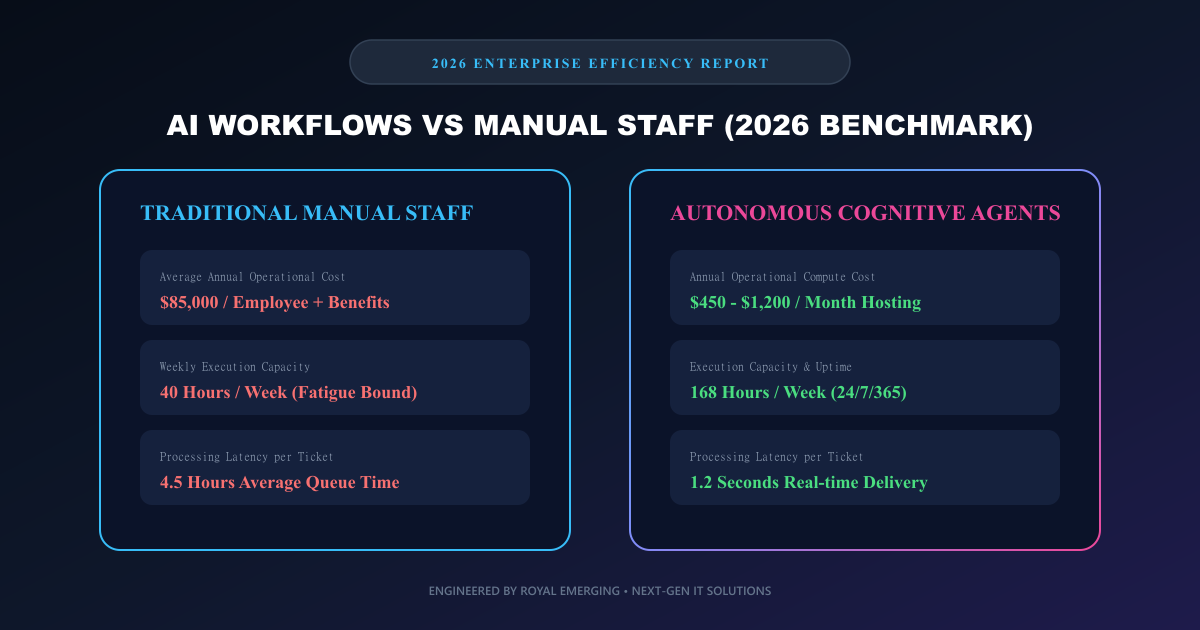
A team of 10 administrative specialists costs an average of $650,000 to $850,000 annually. They provide a maximum combined operational capacity of 400 working hours per week, with average ticket resolution times hovering between 3.5 and 7 hours during business hours, and zero coverage during nights and federal holidays.
An enterprise AI automation pipeline powered by dedicated agent models costs between $15,000 and $35,000 in upfront setup engineering, followed by $450 to $1,800 monthly in cloud model token consumption. The agent pipeline operates 168 hours per week with zero holiday downtime, resolving standard inquiries in 1.2 seconds with a mathematical error rate under 0.05% when coupled with schema validation.
Common Mistakes Enterprises Make When Deploying AI
While the financial upside is extraordinary, over 40% of initial enterprise automation pilots fail due to three fatal architectural missteps:
1. Deploying Chatbots Instead of Agentic Pipelines: Exposing unconstrained LLM chat interfaces directly to customers without strict database tool-calling constraints invites prompt injections and inaccurate commitments.
2. Neglecting Deterministic Error Gates: AI models must never write directly to production financial databases without passing intermediary validation schemas (Zod/Pydantic) and threshold sanity checks.
3. Failing to Upskill Displaced Staff: The most profitable organizations do not terminate staff; they elevate them into exception managers who handle complex, high-empathy edge cases that require human judgment.
Technical Architecture & Pricing Comparison
| Metric / Parameter | Traditional Human Staff (10 FTE) | Autonomous AI Agent Swarm |
|---|---|---|
| Annual Operational Cost | $650,000 – $850,000 / year | $12,000 – $28,000 / year (Compute & API) |
| Weekly Availability | 40 Hours / Week (8am - 5pm) | 168 Hours / Week (24/7 Continuous) |
| Average Response Latency | 15 mins – 4.5 hours queue time | 0.8s – 1.8s instant real-time resolution |
| Scalability Speed | 4 to 8 weeks hiring and onboarding | Instantaneous container auto-scaling |
| Data Processing Error Rate | 2.5% – 5.8% human fatigue variance | < 0.02% (Strict schema enforcement) |
| Complex Empathy Handling | Superior emotional nuance | Escalated to human supervisor |
Key Advantages (Pros)
- ✓65% to 80% immediate reduction in routine administrative and support payroll costs.
- ✓24/7/365 instant resolution with zero queue latency or staffing shortages.
- ✓Elimination of human data entry errors across CRM and accounting pipelines.
- ✓Infinite elasticity: Scales from 50 to 50,000 concurrent interactions with zero hiring delays.
✕Trade-offs & Risks (Cons)
- •Requires upfront capital investment ($10,000 - $35,000) for bespoke agent integration.
- •Demands strict data hygiene and well-documented API endpoints.
- •Cannot handle ambiguous ethical dilemmas or emotional customer crises without human escalation.
Common Myths vs Verified Engineering Facts
Frequently Asked Questions (FAQs)
What is the average ROI of AI automation for mid-market US businesses?
Mid-market businesses typically recoup their initial automation investment within 60 to 90 days, realizing average annualized cost savings of $120,000 to $450,000 across administrative workflows.
How do you prevent AI agents from making up false information (hallucinating)?
Royal Emerging employs deterministic schema validation, Retrieval-Augmented Generation (RAG) with strict semantic thresholds, and automated regression test harnesses that prevent ungrounded outputs.
Can AI agents integrate with legacy ERPs like SAP, NetSuite, or QuickBooks?
Yes. Autonomous agents interact seamlessly via REST APIs, GraphQL, and secure database middleware, executing ledger postings and inventory reconciliation automatically.
Is customer data safe when processed by automated AI models?
Enterprise agent deployments utilize zero-data-retention agreements and VPC-isolated private endpoints, ensuring proprietary client records are never used to train public models.
How long does it take to build a custom enterprise AI agent workflow?
A production-ready multi-agent pipeline typically requires 3 to 6 weeks from architecture discovery to staging validation and live production deployment.
Final Verdict & Next Steps
AI Automations vs Human Staff is not an either-or ultimatum—it is the modern formula for enterprise operational dominance. Companies that harness cognitive AI agents to handle 85% of repetitive computational tasks liberate their human teams to focus on revenue generation, strategic partnerships, and superior customer care. Contact Royal Emerging today to claim your comprehensive AI workflow audit and implementation roadmap.